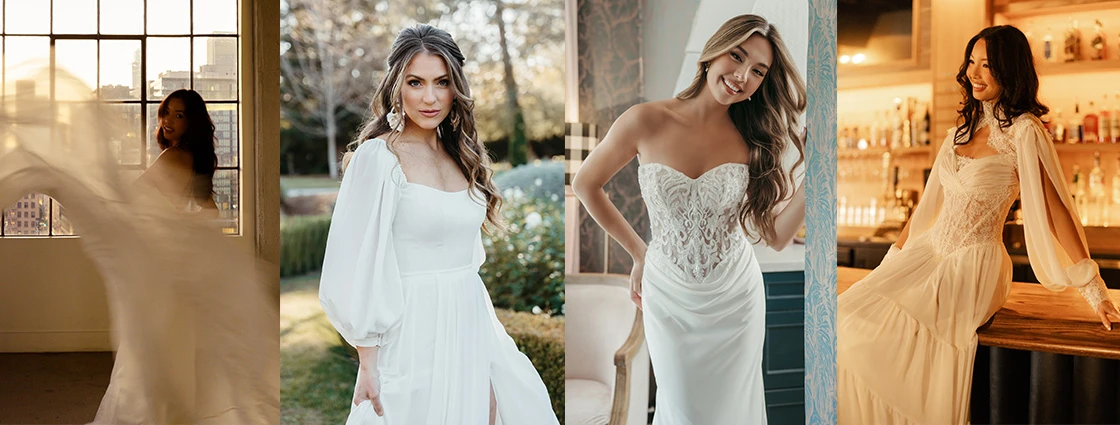
Light, airy and made to move, chiffon is the fabric behind some of bridal’s softest, most romantic gowns. It floats through an A-line skirt, drifts down a sleeve and keeps a lace bodice feeling effortless.
Chiffon wedding dress fabric is a lightweight, finely woven material with a soft drape and a gentle shimmer. Designers layer it, line it and pair it with lace, which is why one chiffon wedding dress can look and feel completely different from the next.
Once you know how a chiffon gown is put together, it’s much easier to find the one you’ll love wearing from the first look to the last dance. We’ll cover what chiffon is, how a gown is built, the styles to try, what it asks of you and what to look for at your appointment.
Still comparing fabrics? Start with our Wedding Dress Fabrics Guide, or take a look at our posts on tulle and crepe, two fabrics brides often weigh against chiffon.
Chiffon Wedding Dress Fabric at a Glance
| Quick Facts | What to Know |
| Feel | Featherlight and soft, with a fine, slightly grainy surface |
| Weight | Very light |
| Finish | Gentle shimmer, or matte and satin-like |
| Drape | Fluid and flowing |
| Best silhouettes | A-line, plus sleeves, slits and detachable pieces |
| Best for | Warm-weather weddings and brides who want movement |
| Pairs well with | Lace, floral details, tie straps, sleeves |
What Is Chiffon Wedding Dress Fabric?
Chiffon is a lightweight plain-weave fabric made from tightly twisted yarns. That twist gives it a fine, slightly grainy surface, a soft shimmer and the drifting movement you notice whenever it’s in motion.
It’s a flowing fabric rather than a structured one. Where Mikado and satin hold their shape, chiffon moves with you, which is why it feels so relaxed and romantic.
Types of Chiffon Wedding Dress Fabric
Chiffon is described in two ways: by what it’s made of (the fiber) and by how it looks (the finish). A gown can be described by both.
| Type | Fiber or Finish? | What It Is | Good to Know |
| Silk Chiffon | Fiber | Chiffon woven from silk | A luminous, luxe look; the most delicate option and the one most prone to creasing |
| Polyester Chiffon | Fiber | Chiffon woven from polyester | Looks very similar from a few feet away; usually creases less and is easier to live with |
| Matte Chiffon | Finish | Chiffon with a soft, low-sheen finish and no glossy shimmer | Reads understated and a little earthy |
| Satin Chiffon | Finish | Chiffon with a smoother, slightly shinier surface, closer to the look of satin | A bit more polished and luminous, but still light and flowing |
Designers don’t always use these terms in exactly the same way, so your True Crew stylist can confirm which chiffon a specific gown uses and how it looks in person.
Why Choose a Chiffon Wedding Dress?
- Movement you can see: The layers lift and settle with every step, so the gown looks as good in motion as it does standing still.
- A light, breathable feel: Our fabrics guide counts chiffon among the most comfortable, breathable fabrics, especially in warm weather.
- A soft, romantic look: Chiffon gives a relaxed, easy elegance that suits everything from simple gowns to lace-trimmed styles.
- Easy pairing: It works beautifully with lace, sleeves, slits and floral details.
- Versatile roles: Chiffon can make up a whole skirt or play a smaller part, like sleeves, a wrap or a detachable layer.
- Wide range of price points: Polyester chiffon can make a beautiful gown more accessible.
How Is a Chiffon Wedding Dress Built?
Here’s the part most brides don’t see on the hanger: a chiffon gown is built in layers, and each layer has a job.
| Layer | What It Does |
| Outer chiffon layers | Create the float and movement you see when the skirt moves |
| Inner layers | Add body and fullness to the skirt |
| Lining | Finishes the gown and determines how it feels against your skin |
| Illusion panels | Soft, skin-tone sections, often at the neckline, back or sides, that keep details light |
The number of layers changes a gown’s personality. Fewer layers read airier and more fluid. More layers add fullness, with slightly less drift. Neither is better, so it comes down to what you want your skirt to do.
When you try on a chiffon gown, ask how many layers the skirt has and what the lining is made of. Both shape how the gown moves and how it feels to wear.
Chiffon Wedding Dress Styles to Try
Chiffon shows up in a gown in a few different ways, and each one changes how the dress looks and wears.
Chiffon A-line Wedding Dresses
When chiffon makes up the whole skirt, you get the most movement. The waist stays defined, then the layers lift and settle with every step. It looks as good in motion as it does standing still, so give each gown a walk and a twirl.
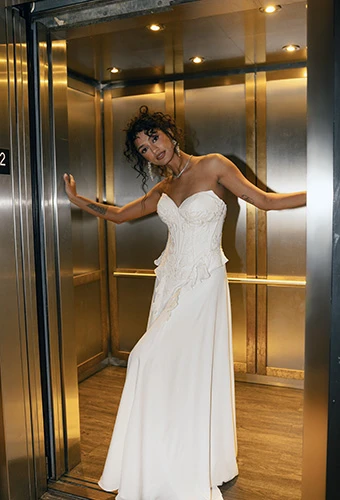
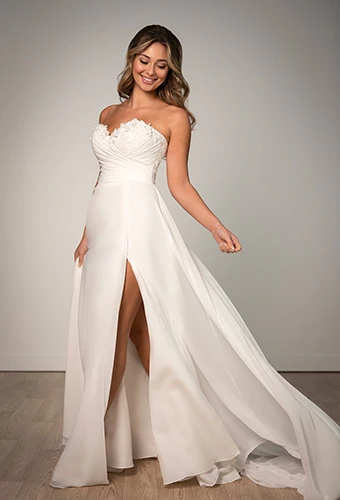
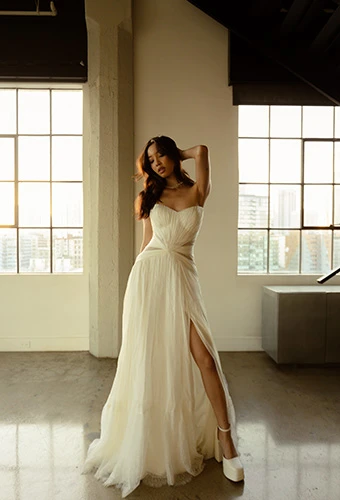
Drawn to a relaxed, free-spirited look? Browse our boho wedding dresses for more chiffon options.
Chiffon Wedding Dresses with Sleeves
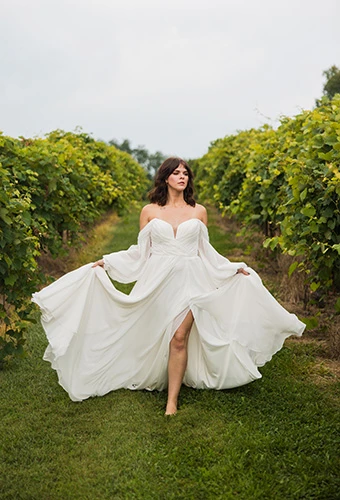
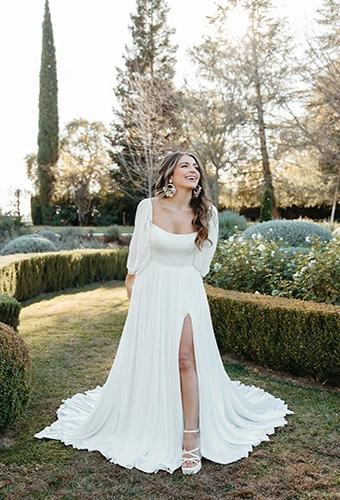
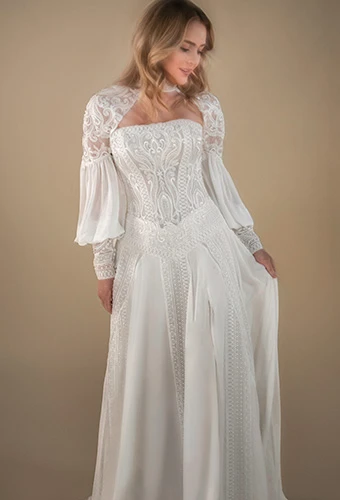
Sleeves are one of chiffon’s best tricks. They add a little drama without adding weight. If you’re searching for a long sleeve chiffon wedding dress, you can also try detachable or removable pieces. That means one gown can give you two looks.
Want to see more? Explore our full long sleeve wedding dress collection.
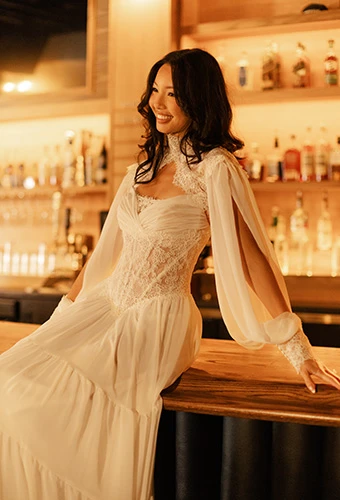
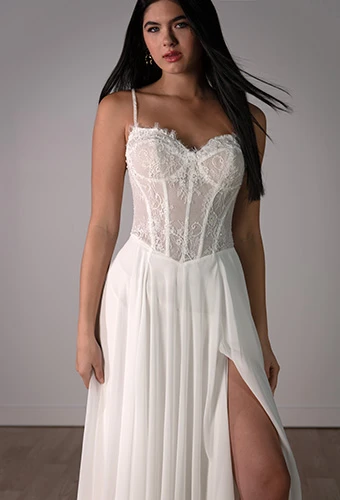
Lace and Chiffon Wedding Dresses
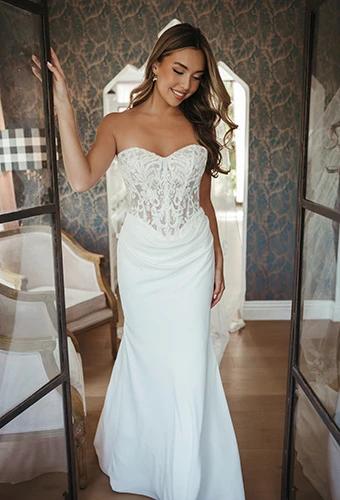
Lace brings the detail, and chiffon keeps everything else light and easy. When you try these on, look closely at where the lace meets the chiffon, since that seam shapes the whole look.
Love the look? Our lace wedding dresses collection has plenty more.
Chiffon vs. Tulle, Satin and Crepe
Chiffon vs. tulle. Both look light and airy, but they behave differently. Chiffon is a woven fabric that drapes and flutters, while tulle is a net that holds volume. Want a skirt that floats and falls? Chiffon fits. Want fullness? Our tulle guide covers it.
Chiffon vs. satin. Satin is glossier and heavier, while chiffon is lighter with a softer sheen. Some gowns pair the two, using a satin lining under chiffon layers for a little extra body.
Chiffon vs. crepe. Both are known for fluid movement, but crepe is typically denser with a matte, subtly textured surface, while chiffon is lighter and airier. Our crepe guide breaks that one down.
Prefer a fabric that holds its shape instead of floating? Our guide to Mikado wedding dress fabric covers it.
Is Chiffon Good for Summer Weddings?
Yes. It’s one of the most popular warm-weather fabrics, and for good reason. Chiffon is light, it floats when you walk and it doesn’t feel heavy, even outdoors.
A few things shape how cool a chiffon gown feels:
- The lining. It’s the layer against your skin, so ask what it’s made of.
- The number of layers. More layers add fullness and a little more weight.
- The cut. Strapless and sleeveless styles feel lighter than long-sleeve ones.
Chiffon isn’t only a summer fabric, either. Detachable sleeves, toppers and collars let you adapt a gown for cooler weather, so one style can work across seasons.
Who Can Wear a Chiffon Wedding Dress?
Chiffon isn’t made for one body type. What shapes your experience is the construction underneath the fabric and how the gown is cut, so let those lead your search.
Chiffon Wedding Dresses for Plus-Size Brides
Chiffon’s light layers add movement without much weight, and many chiffon styles come in plus sizes. What matters most is what’s underneath: a supportive bodice, a lining that feels smooth against your skin and enough layers for the fullness you want.
Whenever possible, try the gown in your own size, since layers fall differently on a sample cut for another frame. Browse our plus-size wedding dress collection and ask your stylist to pull several chiffon styles so you can compare.
Chiffon Wedding Dresses for Petite Brides
Lightweight chiffon helps a smaller frame stay balanced, since the layers are light rather than bulky. Pay attention to where the skirt begins and how long the train runs and choose a length you can manage while you move and dance. A slim A-line gown is a great place to start.
Chiffon Wedding Dresses for Minimalist Brides
When a gown has little embellishment, the details that remain get noticed: a deep V-neckline, an open back, a high slit. With so little competing for attention, chiffon’s movement becomes the main event. Explore our simple wedding dresses to see how clean lines and thoughtful details work together.
Styling Your Chiffon Wedding Dress
Because chiffon moves so easily, accessories that move with it tend to work best.
| If Your Gown Has… | Try Pairing It With… |
| A flowing chiffon skirt | A lightweight, softly textured veil that follows the skirt |
| Chiffon sleeves | Simple earrings and hair swept back so the sleeves stay the focal point |
| A high slit | Statement shoes or delicate ankle jewelry |
| A lace bodice | Understated jewelry that echoes the lace motifs |
| Tie straps | Hair up or to one side so the straps show |
| An open or low back | A veil that starts lower so the back stays visible |
How to Choose the Right Chiffon Wedding Dress
Chiffon looks one way on a hanger and another on a body in motion. A few things to check and ask at your bridal appointment:
- Walk and turn. Watch how the layers separate and settle.
- Ask how many layers the skirt has and what the lining is. Both shape how the gown moves and how comfortable it feels.
- Raise your arms and sit down. See how the sleeves, bodice and skirt respond.
- Ask what’s detachable. Sleeves, collars and toppers can change a gown entirely.
- Ask how to steam and store it. The answer depends on the fiber and construction.
- Ask about bodice support and your size. Boning and built-in support vary from gown to gown.
Find a Chiffon Wedding Dress That Feels True to You
Chiffon is a fabric you have to see in motion to truly understand. On the hanger, it can look quiet. Once you walk, turn and lift your arms, the layers come alive and the same gown becomes something else entirely. That’s why trying it on is the best way to choose.
At True Society, our True Crew can pull a range of chiffon styles, from simple A-lines to lace-trimmed gowns and styles with detachable sleeves, so you can compare how the layers move, how the lining feels and how each detail changes the look.
Book your appointment at a True Society near you, and find the chiffon wedding dress that moves the way you do, from the first look to the last dance.
Chiffon Wedding Dress FAQs
Is chiffon a good fabric for a wedding dress?
Yes, if you like movement and a light feel. It works for simple gowns, lace-trimmed styles and gowns with sleeves, and the right construction gives it more support than the fabric has alone.
What is the difference between matte chiffon and satin chiffon?
Matte chiffon has a soft, low-sheen finish, while satin chiffon is smoother and a bit shinier, closer to the look of satin. Both are lightweight and flowing, so the difference comes down to the amount of shine.
Does chiffon wedding dress fabric wrinkle?
It can. Silk chiffon creases more easily than polyester, and multiple layers can hide small creases. Follow your bridal boutique’s transport advice and leave steaming to a professional.
What is the difference between chiffon and tulle?
Chiffon is a woven fabric with a fluid drape, while tulle is a net that holds volume. Both can look light and airy.
Does chiffon fabric snag easily?
Its fine yarns can catch on jewelry and rough surfaces, so keep rings, bracelets and hair accessories away from the skirt.
Can a chiffon wedding dress be altered?
Often, yes. Because the layers are delicate, work with an alterations professional who has experience with lightweight fabrics.
